

Copyright 101: What is Copyright?
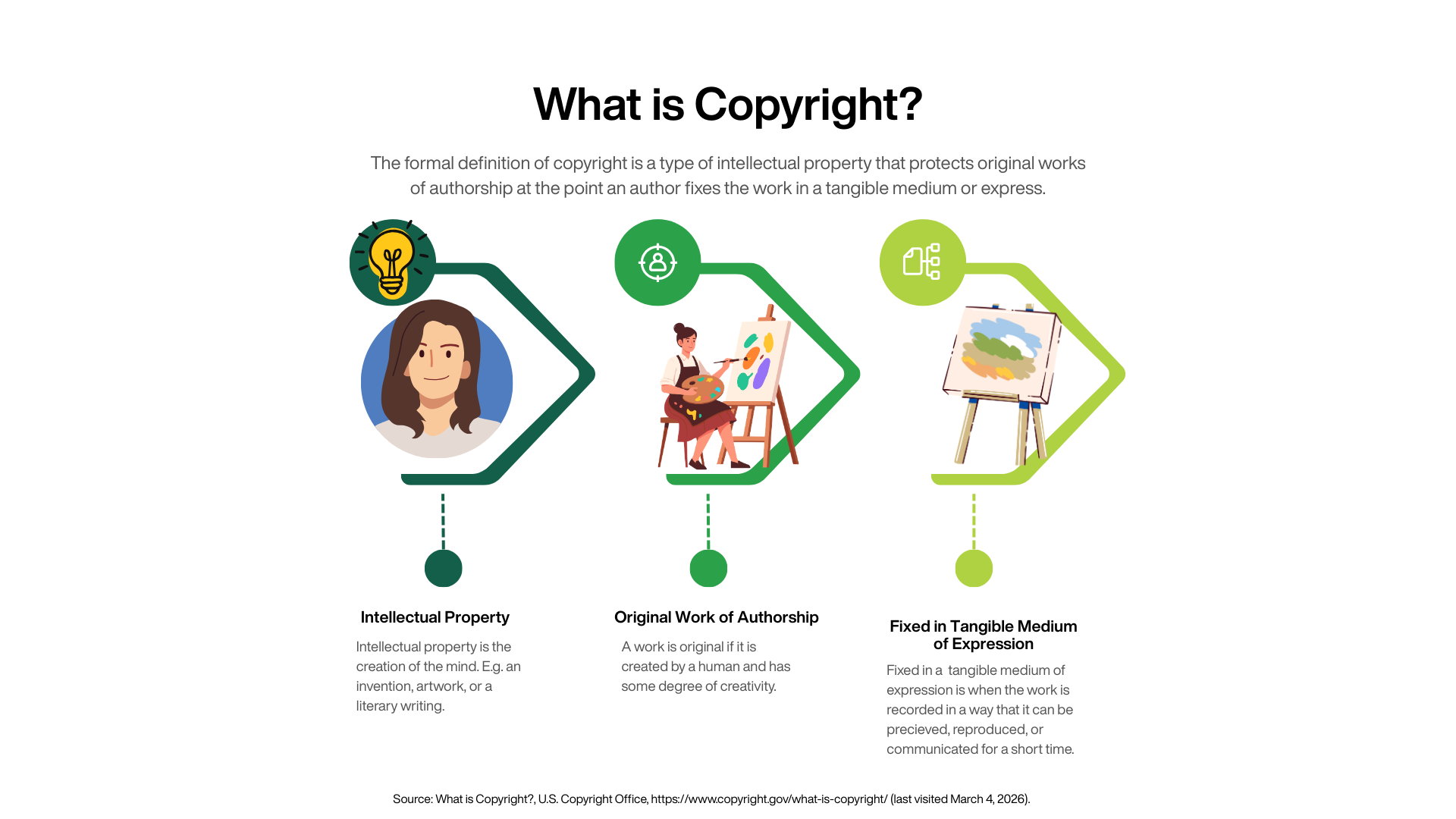
The formal definition of copyright is a type of intellectual property that protects original works of authorship the moment they are fixed in a tangible medium of expression. That can be a mouthful, so let’s break it down:
1. Intellectual Property
Intellectual property is anything created by the mind. Think of a short story, a drawing, or a musical composition.
2. Original Works of Authorship
This requires two things: a human creator and a spark of creativity. To be "original," the work must be independently created by a human and possess at least a minimal degree of creativity.
For example, if you draw a single, plain circle on a white sheet of paper, you’ve met the human requirement, but you likely haven't met the creativity threshold. However, if you add specific colors, unique line weights, or a distinct style, you have moved into the realm of an original work.
3. Fixed in a Tangible Medium of Expression
This means the work is recorded in a way that it can be perceived, reproduced, or communicated for more than a transitory period. An idea staying in your head isn't protected; it has to be written down, filmed, saved to a hard drive, or painted onto a surface.
The Idea vs. The Work Leonardo da Vinci was a brilliant artist. One day, he had the idea to create a portrait titled the Mona Lisa. While the idea was in his head, it was not yet protected by copyright. It only became a protected work once he applied oil to the wood panel.
The Monet Method Consider Claude Monet sitting in his garden. He decides to paint the view of his lily pond. He carefully selects a color palette and chooses specific angles to capture the light.
This qualifies for copyright protection because:
Originality: Monet (a human) created the work himself.
Creativity: He used his judgment to select colors, brushstrokes, and composition.
Fixation: By applying paint to the canvas, he "fixed" the work in a tangible medium.
Source: https://www.copyright.gov/what-is-copyright/